
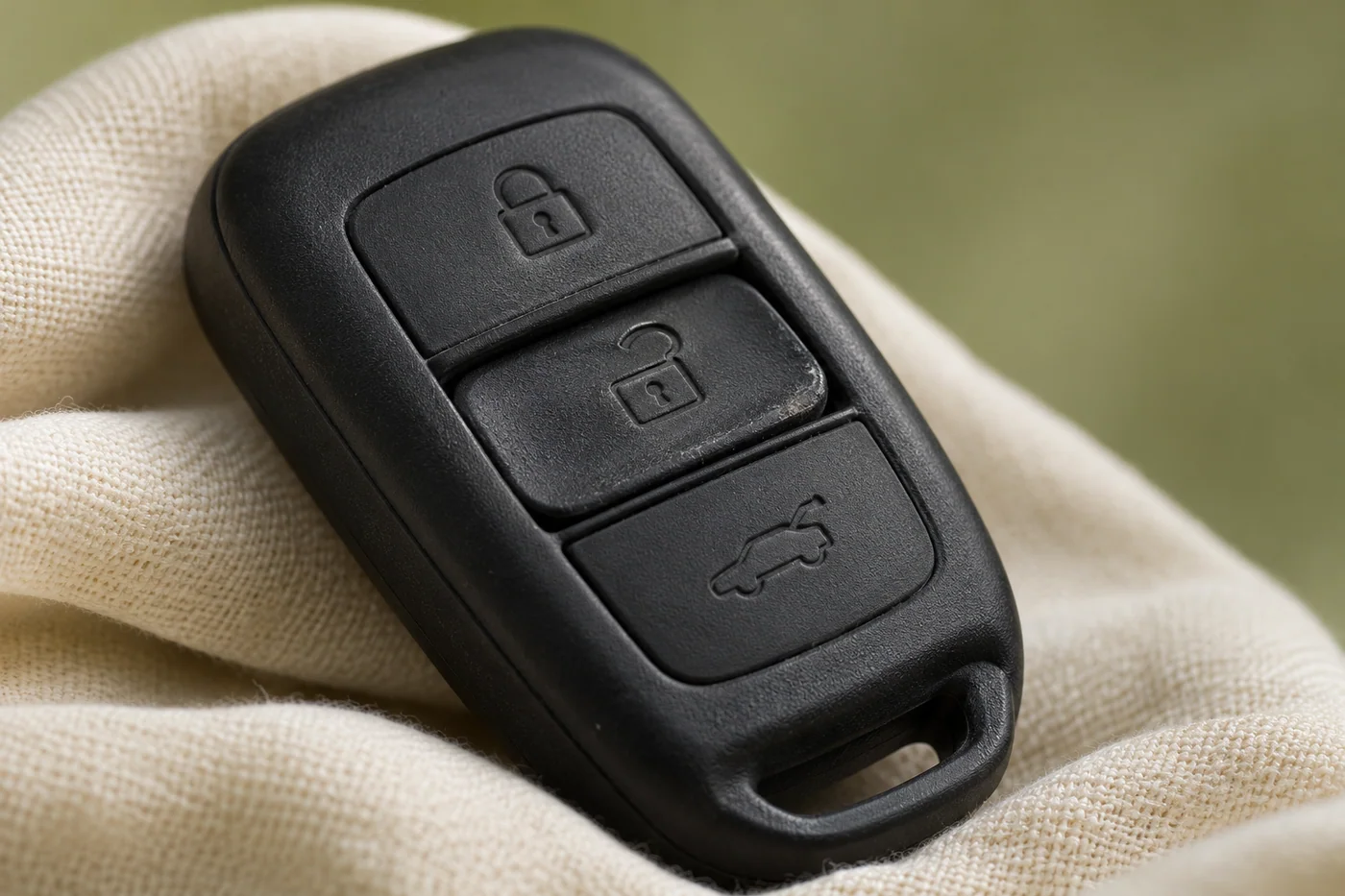
You press the lock button and it doesn't spring back. You may be able to release it with another touch, or it may stay down long enough to make the remote awkward to use.
That is different from a button that moves normally but gets no response from the car. The distinction sounds small, yet it helps keep the assessment focused. A key fob contains more than the case you can see, and not every complaint is a programming problem.
Begin with the part you can observe
Describe whether the button physically stays pressed, feels loose or has lost its usual movement. Mention a split in the case or a change after a drop if you actually noticed one.
Then describe the result separately. Does that button still operate the lock? Do other buttons work? Does the car still recognize the key for starting? You don't need to keep testing a troublesome button just to produce a perfect account.
These facts can guide the next conversation, but none proves a particular internal component is sound or damaged. A remote that still partly works can still need careful assessment.
The case, button and electronics are different things
The outer housing protects the components and positions the controls. The visible button provides the part you press. The electronic parts perform functions that depend on the actual remote and vehicle.
A damaged housing may therefore be one part of the complaint, but a case replacement is not automatically a complete remedy. The fit and condition of the remaining components matter. A look-alike housing from an online listing may not be suitable for your key.
Similarly, programming concerns the relationship between supported electronic equipment and the vehicle. It should not be assumed to correct a button that physically sticks. The proposed work needs to address the condition that was found.
Why washing it is a poor shortcut
Advice about soaking or cleaning a remote can leave out the electronics inside. Don't treat a key fob as an empty plastic shell. Liquids and unsuitable handling can cause additional damage.
Honda's 2017 Civic Hatchback owner information warns about conditions that can harm key circuitry and limits disassembly to its specified battery-replacement exception. That is a model-specific example of why the applicable manual matters; it is not an instruction to open every Honda key or every remote.
If the remote needs professional inspection, explain any cleaning products or liquid exposure it has already had. That history is useful even when the sticking button began before the exposure.
A replacement should solve the right problem
If a new case, repaired assembly or complete remote is proposed, ask what was found and what the work is intended to restore. There may be more than one possible outcome, and suitability depends on the actual hardware.
For a complete remote, confirm the part and any required setup before buying. GM's listing for part 22936099, for example, identifies programming or special setup as required. That requirement belongs to that part; a similar-looking product may have different requirements.
The car key replacement page explains how to define the functions you want in the finished key. A matching button count or case outline is not enough to confirm compatibility.
Keep the vehicle with the story
Have the year, make and model available, with any part details already on the packaging. Mention if the remote is a replacement. Don't pry it apart to find a number.
Tell the person assessing it which functions remain useful and whether another key is available. This is particularly helpful when the fob still starts the car and you want to avoid turning a manageable problem into a missing-key situation.
For a Lakewood-area request, call 562-353-4930 to discuss the vehicle and current availability. The car locksmith overview covers related problems, while the Long Beach page adds the nearby regional context.
What to understand afterward
Know whether the work changed only the outer housing, repaired a component or supplied a different remote. Check the intended functions in ordinary use and keep any relevant part details or care instructions.
A useful explanation leaves you knowing what changed and why. It should not ask you to accept programming as a catch-all answer to every kind of fob trouble.
Questions worth asking
Can a new battery fix a button that stays pressed?
A battery change and a physical button fault are different questions. The symptom needs assessment rather than an assumed battery remedy.
Is a case replacement always cheaper or sufficient?
Neither can be promised from the visible symptom alone. Compatibility, component condition and the actual work determine the appropriate option.
Should I open the fob to see whether the button is damaged?
Do not dismantle it as a diagnostic experiment. Follow the applicable owner information and arrange inspection when the cause is unclear.